


















Table of Contents
Every year, businesses and developers face the same pain point: technology evolves faster than teams can adapt. AI models update monthly, Android ecosystems fragment, and enterprise adoption lags behind innovation. The result is confusion, integration fatigue, and strategic hesitation.
Google’s biggest annual event, Order Klonopin Online Google I/O, scheduled for 2026, is expected to directly address this gap. With a sharp focus on https://fireaid.com/services/ Gemini, Android, cloud intelligence, and AI-native applications, the company appears poised to shift from experimental AI announcements to structured ecosystem integration.
This article explores what to expect from Google I/O 2026, how it could solve real-world business challenges, and what executives, developers, and enterprises should prepare for.
The Core Industry Pain Point: Innovation Without Integration
Organizations today struggle with three main issues:
- AI tools are powerful but disconnected
- Mobile ecosystems lack consistent AI-native functionality
- Developers face rapid API evolution without long-term clarity
If Google’s 2026 strategy succeeds, the solution will not be “more features,” but rather Buy Ambien Online Overnight cohesive AI infrastructure.
Buy Tramadol Without Prescription What to Expect at Google I/O 2026
While official agendas evolve closer to the event, historical trends suggest focus across three pillars:
https://lejaseur.com/l-ecologie/ 1. Gemini Evolution: From Model to Ecosystem
Gemini is expected to move beyond chatbot capabilities into deeper operating system integration.
Anticipated developments:
- Native Gemini integration into Android system layers
- AI-enhanced productivity across Google Workspace
- Multimodal reasoning improvements (text + voice + visual)
- On-device AI processing enhancements
The likely shift is from “AI as an app” to https://celiacmama.com/parenting-tips/ AI as infrastructure.
Buy Xanax Without Rx Gemini’s Strategic Positioning
| https://sagesmilesdental.com/endodontics-calgary/ Capability Layer | Purchase Ambien Online 2024 Focus | Order Tramadol Online Expected 2026 Direction |
| Chat Interface | Conversational | Context-aware AI assistant |
| Multimodal Input | Text + Image | Real-time environment interaction |
| Developer Access | APIs | OS-level embedded intelligence |
| Enterprise Tools | Add-on AI | Core productivity integration |
The move suggests Google aims to normalize AI into everyday workflows rather than treat it as a separate interface.
Android’s AI-Native Future
Android’s evolution is likely to emphasize:
- Predictive system intelligence
- Real-time contextual app suggestions
- On-device processing for privacy
- AI-driven battery and performance optimization
Rather than just visual redesigns, expect structural changes in how Android processes intent and user behavior.
https://drjonesortho.com/office-tour/ Architecture Shift: From Cloud-Only to Hybrid AI
A simplified conceptual architecture for 2026:
User Interaction
↓
On-Device AI Processing
↓
Secure Cloud Augmentation (Gemini)
↓
Personalized Output Layer
This hybrid approach addresses a key pain point: latency + privacy concerns. On-device inference reduces delay and data exposure, while cloud augmentation enables advanced reasoning.
Order Soma 350Mg Online Enterprise Implications
For business leaders, Google I/O 2026 could clarify AI adoption strategies.
| Enterprise Need | Current Challenge | Xanax Buy Without Prescription Expected Solution |
| Workflow Automation | Fragmented AI tools | Unified Gemini integration |
| Mobile Workforce | App overload | Context-aware Android AI |
| Security | Data exposure risk | On-device intelligence |
| Developer Velocity | Constant API changes | Stabilized AI frameworks |
If properly executed, this reduces AI experimentation fatigue.
Real-Time Case Study Patterns
Although 2026 features are forward-looking, patterns from existing implementations reveal potential impact.
Case 1: AI-Assisted Customer Support
Organizations integrating AI copilots into support teams report:
- 25–40% response time reduction
- Improved ticket triage accuracy
- Lower escalation rates
If Gemini becomes deeply embedded into enterprise apps, these efficiencies may become standard rather than premium.
Case 2: Mobile Productivity Acceleration
Companies piloting AI-enhanced Android workflows observed:
- Faster document creation
- Reduced manual scheduling
- Contextual reminders improving task completion
Embedded system intelligence eliminates friction between apps.
Projected Impact Chart (AI Integration Curve)
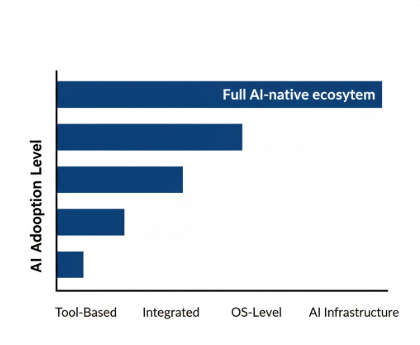
Google’s trajectory appears aimed at the final stage: AI infrastructure rather than feature layering.
Competitive Landscape Comparison
| Company | AI Strategy | Ecosystem Strength |
| Deep OS + Cloud AI integration | Android + Workspace | |
| Microsoft | AI Copilot across Office + Windows | Enterprise dominance |
| Apple | Privacy-first on-device AI | Hardware control |
Google’s differentiator lies in combining Android’s scale with cloud-based Gemini intelligence.
Key Features to Watch at Google I/O 2026
- Gemini-powered Android system assistant
- AI-enhanced Google Search evolution
- Workspace automation upgrades
- Developer tools for multimodal AI apps
- Security & governance frameworks
These features address a common frustration: AI tools that feel isolated.
Strategic Recommendations for Businesses
- Prepare hybrid AI deployment models
- Invest in AI governance frameworks
- Train developers on OS-level integration
- Plan Android AI use cases for field teams
- Evaluate Gemini API roadmaps early
Early adopters gain a competitive advantage.
The Executive Perspective
The real question is not what features Google announces. It is whether Google can solve the integration bottleneck slowing enterprise AI adoption.
If Google I/O 2026 successfully shifts AI from optional add-ons to embedded ecosystem intelligence, it may mark the transition from AI experimentation to AI normalization.
The pain point of fragmented innovation could finally be resolved by structural alignment.